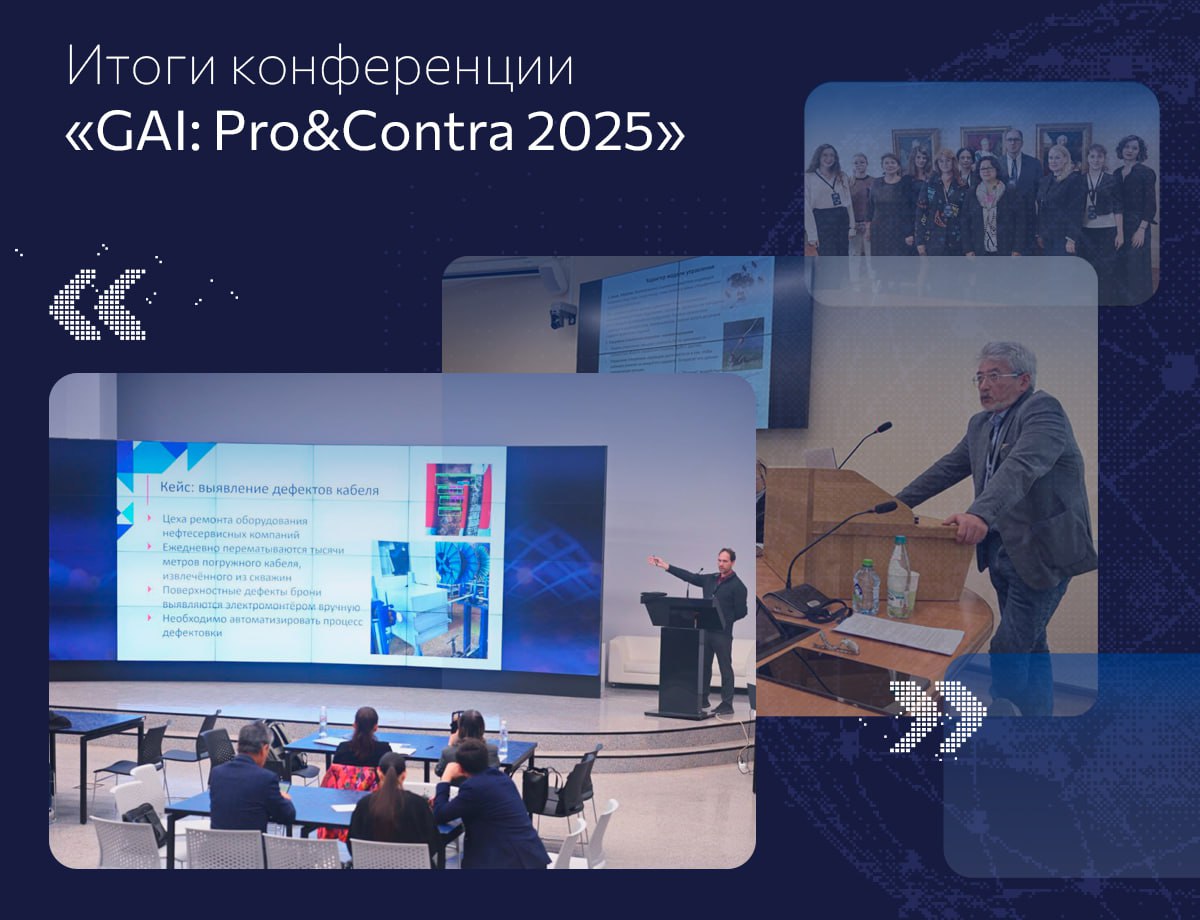
More than 550 people took part in the conference "Generative Artificial Intelligence in Economic and Social Sectors: Pro&Contra 2025", which was held from October 1-4 in offline and online formats in three cities - Moscow, Tomsk and Ufa. This international event brought together experts from academia, business, and government agencies from Russia, Belarus, Kazakhstan, Transnistria (Moldova), Uzbekistan, China, Canada, Pakistan, and Peru. Representatives of 110 organizations, 165 doctors and candidates of sciences of various scientific specialties participated.
The organizers of the conference are the Faculty of Public Administration (FGU) Moscow State University and the University Consortium of Big Data Researchers (Big Data Consortium). The co—organizers are 22 Russian institutions and organizations of science and education.
"Artificial intelligence is not just another new technology, it is a new reality in our lives. AI is beginning to influence security, economics, culture, and science. Today, we are regularly confronted with the fact that open AI models are actively used for "toxic" purposes. But we do not yet have a sufficient legal framework for the development and application of AI technologies and systems. On the one hand, these frameworks should not interfere with the development of AI, but, on the other hand, they should create understandable restrictions on the development of models and their application. And we have already had such an experience with nuclear and genetic technologies in history. We must learn how to use AI in such a way as to preserve the space of meanings and not become hostages of ready-made answers," Vyacheslav Nikonov, Dean of the Faculty of Public Administration at Lomonosov Moscow State University, and Eduard Galazhinsky, Rector of Tomsk State University, expressed this opinion in an address to the participants.
The conference included eight sections with project presentations and discussions.:
"Generative artificial intelligence in science"
The section was held at the All-Russian Institute of Scientific and Technical Information of the Russian Academy of Sciences (VINITI RAS). The Faculty of Public Administration of the Lomonosov Moscow State University and the Scientific Council of the Presidium of the Russian Academy of Sciences on the Methodology of Artificial Intelligence and Cognitive Research also participated in its organization. The section meeting was attended by about 100 people (face-to-face and online) from Russia, Belarus and Kazakhstan. The experts presented 22 reports and discussed with colleagues a wide range of issues related to the use of GII in scientific research, including the risks of such use and criteria for evaluating the quality of scientific research.
The most pressing topic is the quality and reliability of information obtained with the help of AI, the need for standardization and regulation of AI, as well as the quality and reliability of datasets on which AI systems are trained. Much attention was also paid to assessing the state of the field of presenting information on the results of scientific research, and rating scientific journals.
"Generative AI in education"
The section was held at the Faculty of Pedagogical Education of Lomonosov Moscow State University. The MSU Faculty of Public Administration and the MSU Center for the Development of Electronic Educational Resources also participated in its organization. The meeting consisted of two parts: The strategic session "GII in Education: strategies and methodological approaches" and the round table "Generative artificial intelligence as a tool for improving the quality of education and training for the innovative economy: Russian and foreign experience". More than 180 people participated in person and online, including representatives from China and Uzbekistan. The most problematic issues of the section were the risks of using GII in education and the need to establish rules for its use.
"Cybernetic AI in economics"
The section was held at the site of the Faculty of Public Administration of Lomonosov Moscow State University. The Central Economic and Mathematical Institute of the Russian Academy of Sciences, the Scientific Council under the Presidium of the Russian Academy of Sciences on Artificial Intelligence Methodology and Cognitive Research, and the Faculty of Economics of Lomonosov Moscow State University also participated in its organization. 20 speakers and 135 participants (mostly online) - scientists, practitioners, teachers of leading Russian universities, students and postgraduates from Russia, China, Belarus and Kazakhstan - discussed topical issues of cybernetic artificial intelligence.
The main discussion revolved around the inapplicability of existing models of collecting and processing economic information for planning the economy in the direction of increasing the quality of life. Most of the speakers were inclined to the need to introduce cybernetic artificial intelligence in Russia, based on the use of the full range of modern digital technologies, including AI, and the planning experience of the USSR State Planning Committee to improve the effectiveness of management decisions.
"The use of generative artificial intelligence in jurisprudence and its regulatory legal regulation"
The section was held at the site of the Lomonosov Moscow State University Faculty of Law. The Faculty of Public Administration of Moscow State University and the Institute of Legislation and Comparative Law under the Government of the Russian Federation participated in its organization. There were 12 speakers, including experts from Peru, China, Pakistan and Uzbekistan. More than 80 people have registered for the section.
The participants agreed that one of the most terrible consequences of using AI in law and public administration may be the loss of control over it. The ideas raised about the quasi-subjectivity of artificial intelligence, the limitation of responsibility for its development and application, and risks in public administration are related to the need to establish and maintain human control over AI and its use. It is proposed to assign control over the use of artificial intelligence to the state (including the courts) and the main players in the market.
"Ethics and values of generative artificial intelligence"
The section was held at the Institute of Philosophy of the Russian Academy of Sciences. It was organized by the Faculty of Public Administration of Moscow State University and the Scientific Council at the Presidium of the Russian Academy of Sciences on the Methodology of Artificial Intelligence and Cognitive Research. The Section consisted of two sessions. The first one featured 12 speakers, with a total of 30 experts participating. The main question was devoted to the goals and possibilities of developing generative artificial intelligence. Some participants in the discussion noted that GII serves to govern the state and society and destroys human intelligence, while others emphasized the positive results of its application and suggested methods to optimize the consequences of using GII.
The second meeting brought together 25 people, including 11 speakers. Ethical issues related to the phenomenon of "tanabots" - digital doppelgangers of deceased people - became the subject of a lively discussion. Some experts considered promising the model proposed by the speaker for describing a person as an environment within which a new type of technical entity is formed, while others defended classical ideas about human subjectivity. The participants also raised the issue of a person's right to prohibit the creation of a digital double after their own death.
"AI agents"
The section was held at Tomsk State University. The University Consortium of Big Data Researchers participated in its organization. The meeting was attended by 30 specialists (face-to-face and online), 12 experts made presentations on the practical implementation and development of intelligent agents in various fields. Almost every speaker noted that the ethics of using artificial intelligence requires a lot of attention from developers and users, especially in such sensitive areas as health and education
"Generative artificial intelligence and the labor market"
The meeting of the scientific section was held at the House of the Eurasian Scientific and Educational Center of the Republic of Bashkortostan in Ufa. Ufa University of Science and Technology, Vologda Scientific Center of the Russian Academy of Sciences and the University Consortium of Big Data Researchers also participated in the organization of this section. The meeting was preceded by two panel discussions on the staffing of the chemical industry and the practice of using artificial intelligence in public administration, business and the financial sector.
About 50 people participated in the work of the section, 7 reports were presented. Among the issues are the risks of dequalification of employees under the influence of artificial intelligence and issues of responsibility for the results of its application in real practice. Experts stressed that the introduction of AI hardly leads to unemployment or shorter working hours: for all its advantages, artificial intelligence is not able to replace humanity, thanks to which technology works for people, and not vice versa.
"Application of AI technologies and systems in shaping Industry 5.0"
The meeting was held at the Moscow Institute of Physics and Technology. The Club of Directors of Science and Innovation (iR&Dclub), Rostec Group of Companies and United Engine Corporation were also among the organizers of the section. The section was attended by 20 people, including speakers from Russia and Kazakhstan. The experts discussed the practical application of GII in industrial processes. Today, its introduction into production chains is minimal, while traditional non-generative AI solutions demonstrate high efficiency and demand in high-tech industries. All participants emphasized the need for interdisciplinary dialogue and collaboration between regulators, business and the scientific community to overcome barriers to the introduction of AI and form a sustainable foundation for the development of Industry 5.0.
For reference:
For the first time, a conference of this format was organized in 2024 by the Faculty of Public Administration of Lomonosov Moscow State University and was held under the title "Generative AI in Science, Education, Economics and Public Administration: Pro&Contra". Within its framework, three sections were held with the participation of 195 specialists from Russia, China, Italy, Uzbekistan, Kazakhstan, Turkmenistan, Serbia and Cyprus.
The organizers of the conference are the Faculty of Public Administration (FGU) Moscow State University and the University Consortium of Big Data Researchers (Big Data Consortium). The co—organizers are 22 Russian institutions and organizations of science and education.
"Artificial intelligence is not just another new technology, it is a new reality in our lives. AI is beginning to influence security, economics, culture, and science. Today, we are regularly confronted with the fact that open AI models are actively used for "toxic" purposes. But we do not yet have a sufficient legal framework for the development and application of AI technologies and systems. On the one hand, these frameworks should not interfere with the development of AI, but, on the other hand, they should create understandable restrictions on the development of models and their application. And we have already had such an experience with nuclear and genetic technologies in history. We must learn how to use AI in such a way as to preserve the space of meanings and not become hostages of ready-made answers," Vyacheslav Nikonov, Dean of the Faculty of Public Administration at Lomonosov Moscow State University, and Eduard Galazhinsky, Rector of Tomsk State University, expressed this opinion in an address to the participants.
The conference included eight sections with project presentations and discussions.:
"Generative artificial intelligence in science"
The section was held at the All-Russian Institute of Scientific and Technical Information of the Russian Academy of Sciences (VINITI RAS). The Faculty of Public Administration of the Lomonosov Moscow State University and the Scientific Council of the Presidium of the Russian Academy of Sciences on the Methodology of Artificial Intelligence and Cognitive Research also participated in its organization. The section meeting was attended by about 100 people (face-to-face and online) from Russia, Belarus and Kazakhstan. The experts presented 22 reports and discussed with colleagues a wide range of issues related to the use of GII in scientific research, including the risks of such use and criteria for evaluating the quality of scientific research.
The most pressing topic is the quality and reliability of information obtained with the help of AI, the need for standardization and regulation of AI, as well as the quality and reliability of datasets on which AI systems are trained. Much attention was also paid to assessing the state of the field of presenting information on the results of scientific research, and rating scientific journals.
"Generative AI in education"
The section was held at the Faculty of Pedagogical Education of Lomonosov Moscow State University. The MSU Faculty of Public Administration and the MSU Center for the Development of Electronic Educational Resources also participated in its organization. The meeting consisted of two parts: The strategic session "GII in Education: strategies and methodological approaches" and the round table "Generative artificial intelligence as a tool for improving the quality of education and training for the innovative economy: Russian and foreign experience". More than 180 people participated in person and online, including representatives from China and Uzbekistan. The most problematic issues of the section were the risks of using GII in education and the need to establish rules for its use.
"Cybernetic AI in economics"
The section was held at the site of the Faculty of Public Administration of Lomonosov Moscow State University. The Central Economic and Mathematical Institute of the Russian Academy of Sciences, the Scientific Council under the Presidium of the Russian Academy of Sciences on Artificial Intelligence Methodology and Cognitive Research, and the Faculty of Economics of Lomonosov Moscow State University also participated in its organization. 20 speakers and 135 participants (mostly online) - scientists, practitioners, teachers of leading Russian universities, students and postgraduates from Russia, China, Belarus and Kazakhstan - discussed topical issues of cybernetic artificial intelligence.
The main discussion revolved around the inapplicability of existing models of collecting and processing economic information for planning the economy in the direction of increasing the quality of life. Most of the speakers were inclined to the need to introduce cybernetic artificial intelligence in Russia, based on the use of the full range of modern digital technologies, including AI, and the planning experience of the USSR State Planning Committee to improve the effectiveness of management decisions.
"The use of generative artificial intelligence in jurisprudence and its regulatory legal regulation"
The section was held at the site of the Lomonosov Moscow State University Faculty of Law. The Faculty of Public Administration of Moscow State University and the Institute of Legislation and Comparative Law under the Government of the Russian Federation participated in its organization. There were 12 speakers, including experts from Peru, China, Pakistan and Uzbekistan. More than 80 people have registered for the section.
The participants agreed that one of the most terrible consequences of using AI in law and public administration may be the loss of control over it. The ideas raised about the quasi-subjectivity of artificial intelligence, the limitation of responsibility for its development and application, and risks in public administration are related to the need to establish and maintain human control over AI and its use. It is proposed to assign control over the use of artificial intelligence to the state (including the courts) and the main players in the market.
"Ethics and values of generative artificial intelligence"
The section was held at the Institute of Philosophy of the Russian Academy of Sciences. It was organized by the Faculty of Public Administration of Moscow State University and the Scientific Council at the Presidium of the Russian Academy of Sciences on the Methodology of Artificial Intelligence and Cognitive Research. The Section consisted of two sessions. The first one featured 12 speakers, with a total of 30 experts participating. The main question was devoted to the goals and possibilities of developing generative artificial intelligence. Some participants in the discussion noted that GII serves to govern the state and society and destroys human intelligence, while others emphasized the positive results of its application and suggested methods to optimize the consequences of using GII.
The second meeting brought together 25 people, including 11 speakers. Ethical issues related to the phenomenon of "tanabots" - digital doppelgangers of deceased people - became the subject of a lively discussion. Some experts considered promising the model proposed by the speaker for describing a person as an environment within which a new type of technical entity is formed, while others defended classical ideas about human subjectivity. The participants also raised the issue of a person's right to prohibit the creation of a digital double after their own death.
"AI agents"
The section was held at Tomsk State University. The University Consortium of Big Data Researchers participated in its organization. The meeting was attended by 30 specialists (face-to-face and online), 12 experts made presentations on the practical implementation and development of intelligent agents in various fields. Almost every speaker noted that the ethics of using artificial intelligence requires a lot of attention from developers and users, especially in such sensitive areas as health and education
"Generative artificial intelligence and the labor market"
The meeting of the scientific section was held at the House of the Eurasian Scientific and Educational Center of the Republic of Bashkortostan in Ufa. Ufa University of Science and Technology, Vologda Scientific Center of the Russian Academy of Sciences and the University Consortium of Big Data Researchers also participated in the organization of this section. The meeting was preceded by two panel discussions on the staffing of the chemical industry and the practice of using artificial intelligence in public administration, business and the financial sector.
About 50 people participated in the work of the section, 7 reports were presented. Among the issues are the risks of dequalification of employees under the influence of artificial intelligence and issues of responsibility for the results of its application in real practice. Experts stressed that the introduction of AI hardly leads to unemployment or shorter working hours: for all its advantages, artificial intelligence is not able to replace humanity, thanks to which technology works for people, and not vice versa.
"Application of AI technologies and systems in shaping Industry 5.0"
The meeting was held at the Moscow Institute of Physics and Technology. The Club of Directors of Science and Innovation (iR&Dclub), Rostec Group of Companies and United Engine Corporation were also among the organizers of the section. The section was attended by 20 people, including speakers from Russia and Kazakhstan. The experts discussed the practical application of GII in industrial processes. Today, its introduction into production chains is minimal, while traditional non-generative AI solutions demonstrate high efficiency and demand in high-tech industries. All participants emphasized the need for interdisciplinary dialogue and collaboration between regulators, business and the scientific community to overcome barriers to the introduction of AI and form a sustainable foundation for the development of Industry 5.0.
For reference:
For the first time, a conference of this format was organized in 2024 by the Faculty of Public Administration of Lomonosov Moscow State University and was held under the title "Generative AI in Science, Education, Economics and Public Administration: Pro&Contra". Within its framework, three sections were held with the participation of 195 specialists from Russia, China, Italy, Uzbekistan, Kazakhstan, Turkmenistan, Serbia and Cyprus.